
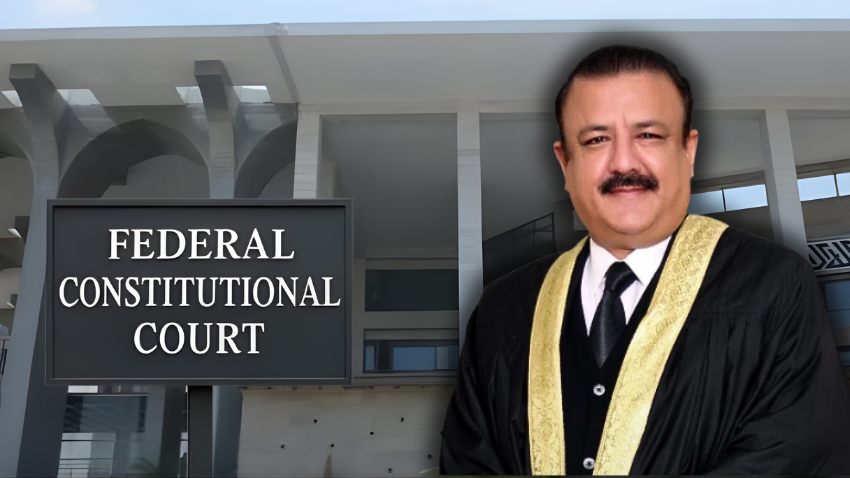
Former Islamabad High Court (IHC) judge Tariq Mehmood Jahangiri has filed a petition in the Federal Constitutional Court challenging his removal from the IHC.
He was removed in December last year after an IHC division bench ruled that his appointment was “without lawful authority”. The order was later acted upon by President Asif Ali Zardari.
The verdict was issued by a bench led by IHC Chief Justice Sardar Muhammad Sarfraz Dogar and Justice Muhammad Azam Khan. The case arose from a petition questioning the validity of Jahangiri’s law degree and, as a result, his eligibility to serve as a high court judge.
The original plea was filed by lawyer Mian Dawood, who has now been named as a respondent in Jahangiri’s FCC petition. Other respondents include the Federation of Pakistan, the president, the Judicial Commission of Pakistan, the former parliamentary committee for judges’ appointments, the Higher Education Commission, and the University of Karachi.
Also Read: Court declares Omar Ayub, Ali Amin Gandapur absconders in Haqeeqi Azadi March case
In his petition, Jahangiri claimed that an “orchestrated campaign” led to his removal through a writ of quo warranto issued by his own court. He argued that this was not a personal loss but a serious blow to judicial independence.
“He is satisfied with the public service he has rendered and his adherence to the dictates of his conscience and his constitutional oath,” the petition stated. However, it added that the move was “a mortal blow to the independence of the judiciary” under the Constitution.
The plea warned that if the issue was not corrected, it would send a negative message to serving and future judges.
Jahangiri argued that the IHC order relied on assumptions rather than facts. He said the court wrongly assumed he did not hold a valid LLB degree, which it treated as a requirement for being an advocate.
The petition quoted the IHC order stating that since Jahangiri “could not be considered as an advocate”, he was not eligible to be appointed as a judge under Article 175-A of the Constitution.
However, Jahangiri argued that the qualifications for high court judges are laid down in Article 193, not Article 175-A, and that an LLB degree is not listed as a requirement there.
He further said that no court or authority had declared his degree invalid at the time of his appointment. The University of Karachi, which issued his degree, declared it invalid only in 2024, years after his elevation.
The petition stated that the University of Karachi’s declaration was later suspended by the Sindh High Court, making it legally ineffective. Despite this, the IHC order gave the declaration retrospective effect.
Also Read: PSL’s Multan Sultans sold for record Rs2.45 billion
Jahangiri also challenged the IHC bench’s authority to rule on the validity of his degree, arguing that it had no jurisdiction to do so and relied on conjecture.
Regarding his license as an advocate, the plea said the relevant bar council had clearly confirmed that Jahangiri was a licensed advocate and that no complaint had ever been filed against him.
The bar council had even asked the court to summon its records, but the bench chose not to do so and instead made assumptions, the petition added.
The plea concluded that the IHC order was unconstitutional, lacked legal basis, and went beyond the scope of ‘quo warranto’ jurisdiction.