
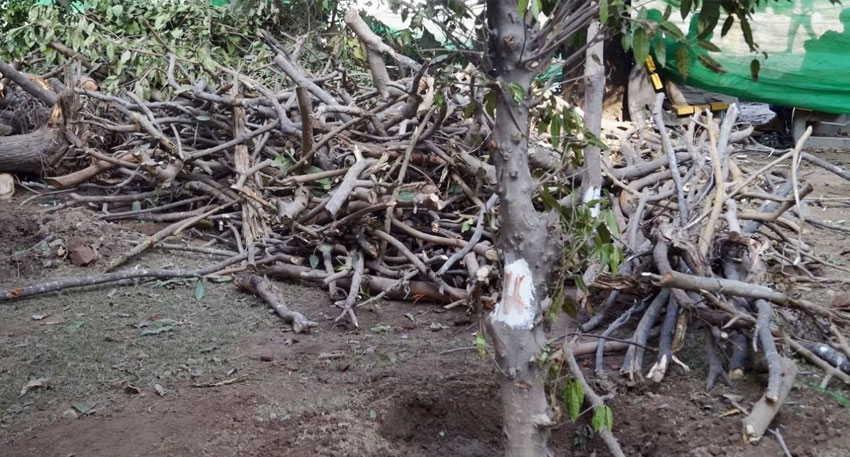
What began as an “improvement plan” in 2023, when officials promised fresh grass and enhanced landscaping, has now turned into large-scale removal of mature trees. Current reports confirm that over 300 established trees have already been uprooted to make room for a parking plaza near the Civil Secretariat. A specialized tree-shifting team worked continuously to relocate them within the park, but experts note that the survival rate of transplanted mature trees is significantly lower than claimed. In urban planning terms, the ecological value of an old tree cannot be replaced by simply moving it or planting saplings.
.jpg)
The ongoing demolition of the park’s long-standing marble fountain adds another layer to the controversy, underscoring how historical structures are often secondary considerations during development projects.
Heritage Significance Backed by Urban History
Nasir Bagh’s importance stretches far beyond greenery. Historically known as Anarkali Garden, Bandstand Garden, Company Bagh, Soldier’s Bagh, Municipal Garden, and Gole Bagh, the site reflects the layered evolution of Lahore’s urban identity. Its current location — between Lower Mall and Kutchery Road — places it at the core of Lahore’s intellectual and cultural district. It is bordered by institutions such as GCU, NCA, UVAS, PUCAD, and landmarks including Lahore Museum, GPO, Urdu Bazaar, Old Anarkali, and Pak Tea House.
From an urban-planning perspective, this zone is one of the few remaining “heritage corridors” of Lahore. Removing a large proportion of its trees has long-term consequences for its cultural landscape and environmental resilience.
A Larger Structural Problem: Lahore’s Declining Green Cover
Data from environmental groups and urban researchers shows that Lahore has lost nearly 75% of its trees over the last two decades. The city’s green cover has dropped to 3.3%, starkly below the global urban-environment standard of 36%. The primary drivers are rapid expansion of housing societies, conversion of green spaces for commercial projects, and construction of flyovers, underpasses, and large-scale infrastructure.
This reduction directly impacts Lahore’s environmental conditions. Research highlights:
• Air Quality: Lahore repeatedly ranks among the world’s most polluted cities. Trees act as natural air filters; their removal reduces the city’s ability to absorb PM2.5 particles.
• Urban Heat: Regions with low green cover record significantly higher surface temperatures, contributing to extreme heatwaves.
• Groundwater Stress: Trees support groundwater recharge. Their loss accelerates water depletion — already a critical issue in Lahore.
• Public Health Costs: Increased pollution correlates with higher rates of respiratory illnesses, economic loss, and strain on healthcare systems.
Policy vs. Practical Implementation
The Punjab government’s afforestation initiatives sound promising on paper, but the challenge remains enforcement. Planting new forests while removing mature trees in central urban zones undermines the broader environmental agenda. Mature trees provide canopy, biodiversity, and microclimate benefits that saplings will take decades to replicate.
The Nasir Bagh development reflects a pattern seen across Lahore: environmental considerations remain secondary to construction-led growth.
Why Nasir Bagh Matters for the Future
Urban researchers argue that cities cannot afford to lose established central green spaces. They act as carbon sinks, reduce heat islands, support public health, preserve cultural memory, and balance built infrastructure. Removing mature trees from Nasir Bagh may temporarily solve parking shortages, but it deepens Lahore’s long-term environmental vulnerabilities.
Nasir Bagh is, therefore, not just another green patch — it represents the urgent crossroads where Lahore stands today. The decisions made here will define whether development in the city moves toward sustainability or continues down a path of environmental decline.