
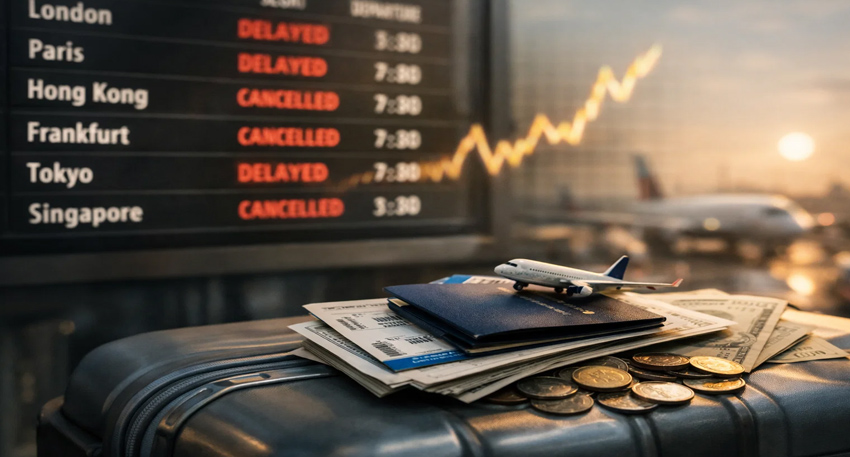
Airfares between Asia and Europe have surged sharply following the closure of key Middle Eastern aviation hubs amid the ongoing US–Israel conflict with Iran. The disruption has significantly reduced global flight capacity on some of the world’s busiest international routes, triggering higher ticket prices and limited seat availability.
Major airlines and travel agencies report that many popular long-haul flights between Asia, Australia, and Europe are fully booked for several days as travelers rush to secure alternative routes.
Major Aviation Hub Shutdown Disrupts Global Travel
One of the most significant disruptions comes from Dubai International Airport, the world’s busiest airport for international travel. The airport remained closed for the fourth consecutive day, severely affecting global air connectivity.
Dubai normally handles over 1,000 flights daily and serves as a crucial transit hub for long-haul flights connecting Asia, Australia, and Europe. The closure has particularly impacted Gulf carriers such as Emirates and Qatar Airways, which dominate intercontinental travel routes.
Travel agencies report a surge in passenger inquiries as travelers scramble to change or rebook flights.
According to Flight Centre Travel Group, customer calls have increased by 75% since the crisis began, reflecting widespread travel disruption.
Global Managing Director Andrew Stark said many passengers are now rerouting their journeys through alternative hubs including China, Singapore, and the United States.
Airlines Forced to Take Longer Routes
With much of the Middle Eastern airspace restricted, airlines are now attempting to bypass the region using alternative flight paths.
Airlines are rerouting flights:
- North through the Caucasus region and Afghanistan
- South via Egypt, Saudi Arabia, and Oman
These detours significantly increase flight duration, fuel consumption, and operational costs, putting further pressure on airline pricing.
At the same time, rising global oil prices are adding to airline expenses, increasing the likelihood of continued airfare hikes in the coming weeks.
Also Read: Middle East war disrupts Pakistan flights — 145 more routes cancelled
Alternative Airlines See Rising Demand
Airlines that operate outside the Gulf region are experiencing a sharp rise in demand as travelers seek alternative routes.
Carriers benefiting from the shift include:
- Cathay Pacific
- Singapore Airlines
- Turkish Airlines
Flight searches show limited seat availability and sharply higher ticket prices on Asia–Europe routes.
Some examples include:
- Cathay Pacific flights from Hong Kong to London have no economy seats available until March 11, with one-way fares around HK$21,158 ($2,705).
- Qantas has no economy-class seats available on Sydney–London flights until March 17, with fares starting at A$3,129 ($2,220).
- Thai Airways reported fully booked Europe-bound flights, with Bangkok–London tickets reaching 71,190 baht ($2,265) for mid-March departures.
Chinese Airlines Also Increase Ticket Prices
Chinese carriers are also witnessing strong demand on Europe routes.
Economy-class seats on near-term China–UK flights are largely unavailable. A return economy ticket from Beijing to London normally costs under 10,000 yuan ($1,452).
However, the only available Air China ticket for an immediate departure was business class priced at 50,490 yuan one-way, highlighting the sharp surge in prices.
Travel Disruptions Likely to Continue
Aviation analysts warn that global flight disruptions, limited seat availability, and rising ticket prices may continue as long as Middle Eastern airspace remains restricted.
With airlines forced to operate longer routes and global fuel prices climbing, the Asia–Europe travel market could face prolonged instability in the coming weeks.